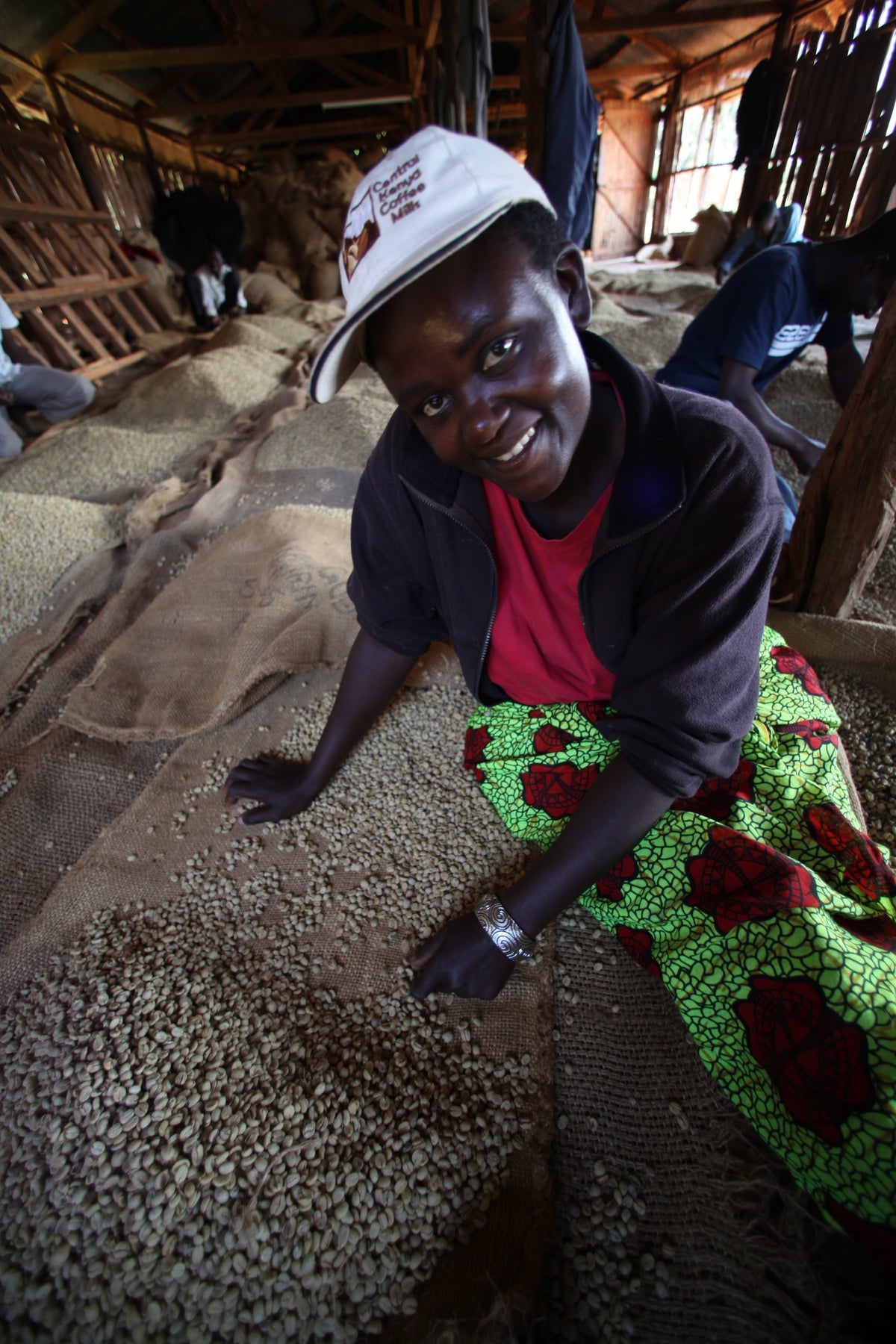
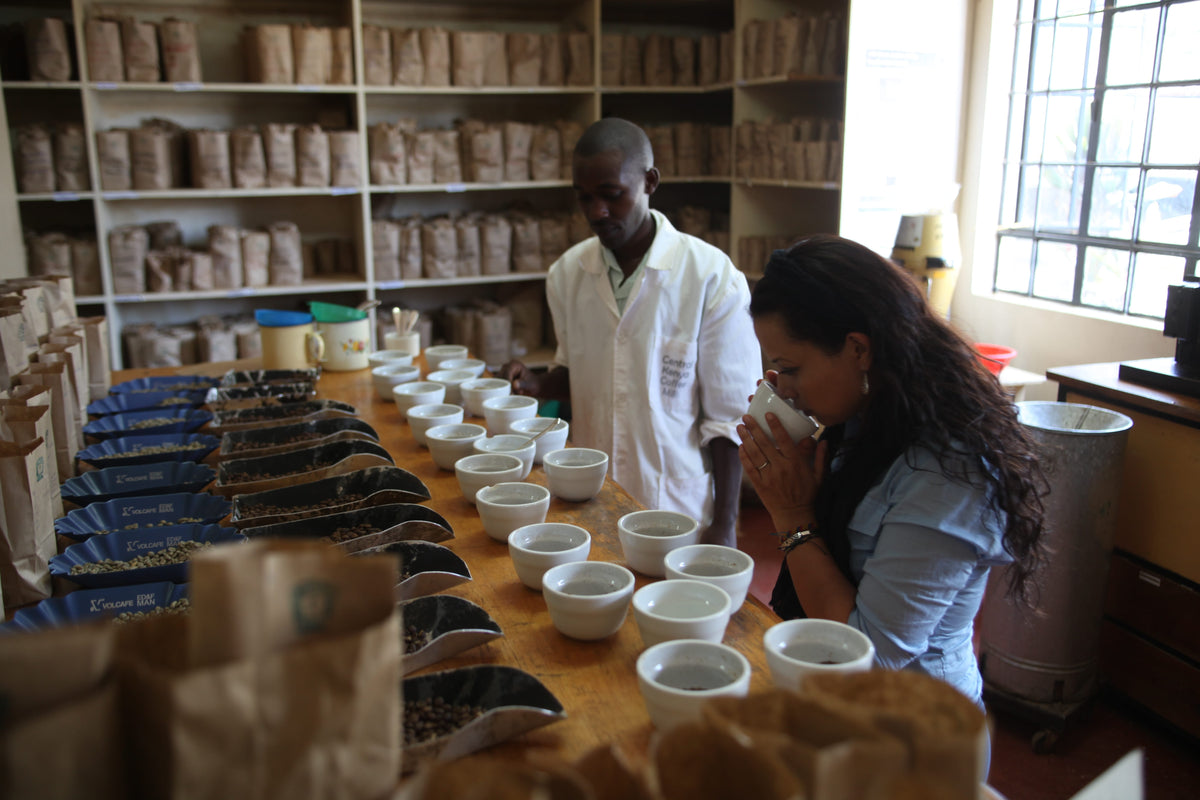
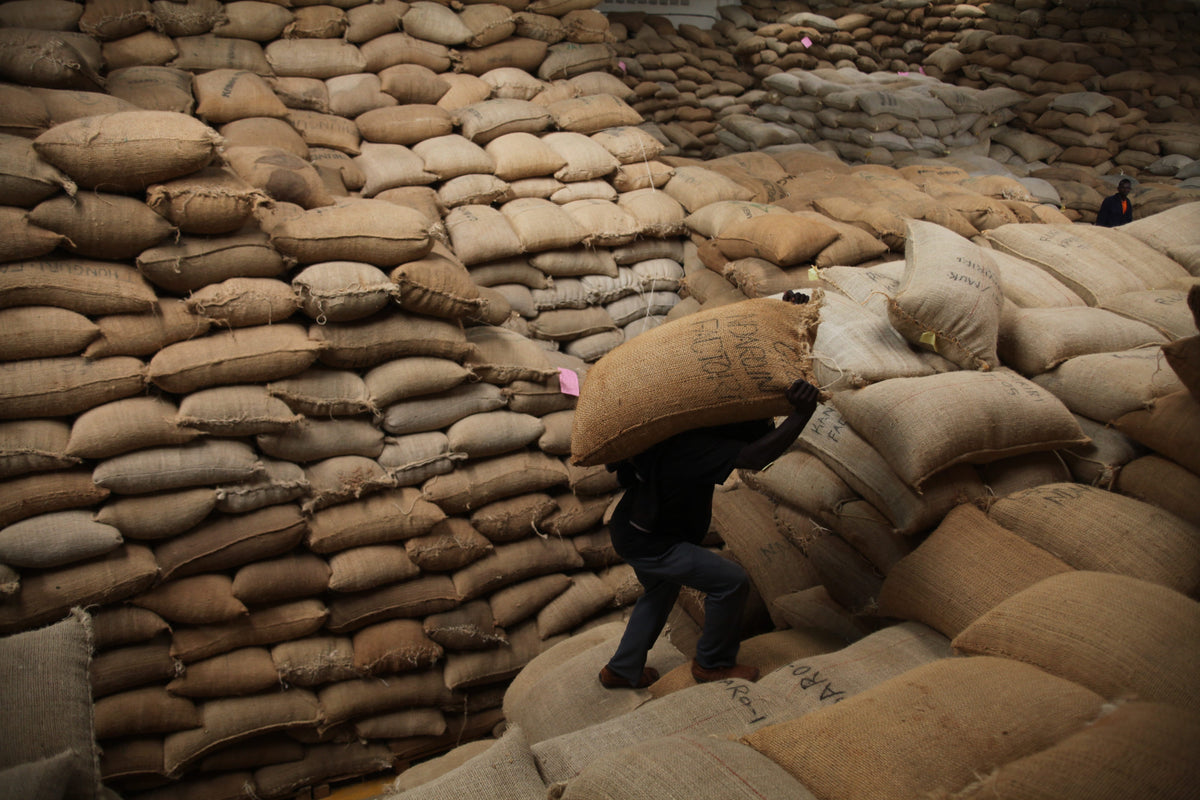
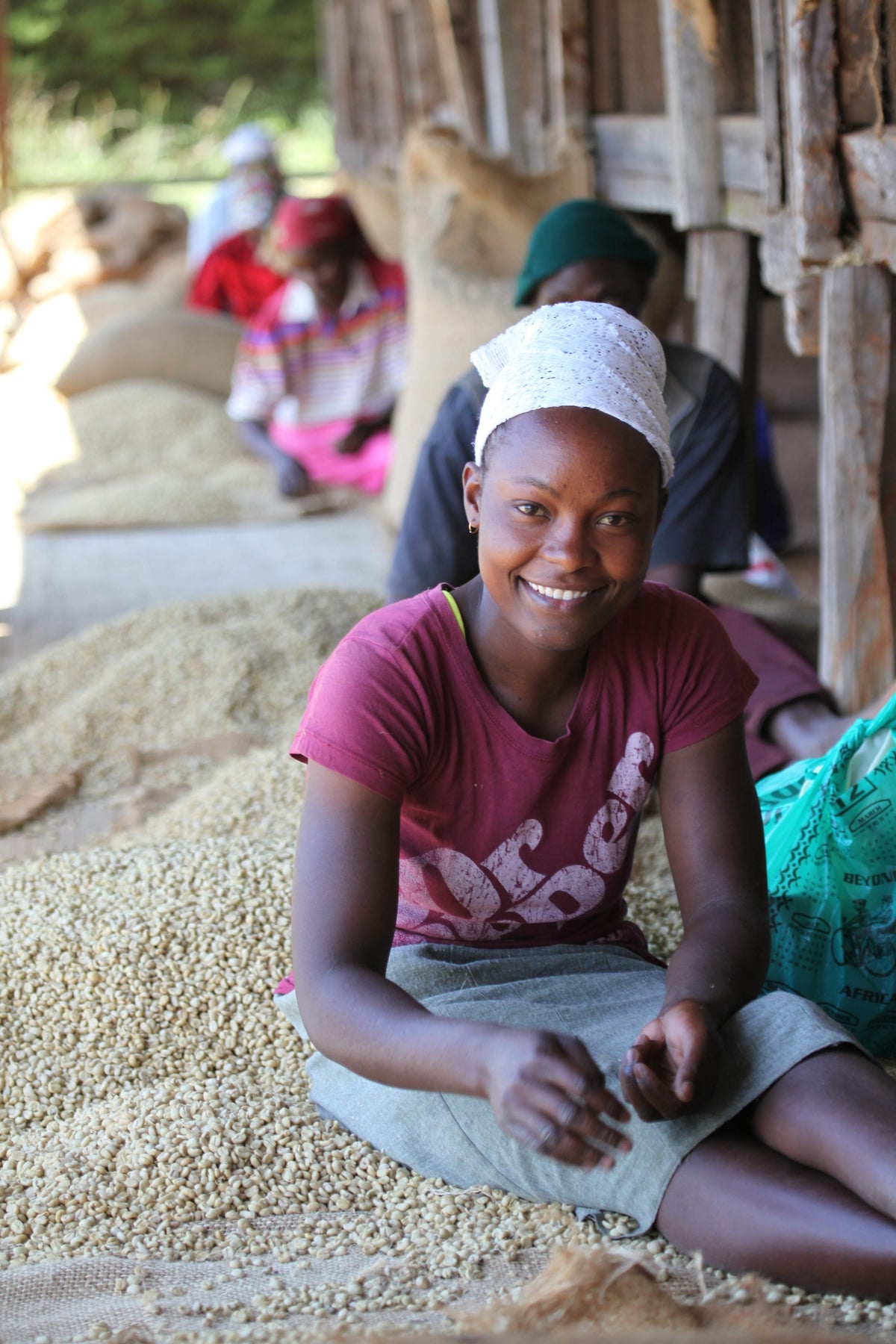
Young woman in a white headscarf smiling at the camera while hand-sorting green coffee in a warehouse
From the source

Kenya

We have bought Kenyan coffee for many years. Nearly every lot has been a washed micro-lot—a small lot kept separate—from a cooperative factory in Murang’a, Nyeri, Kirinyaga or Embu. These coffees have grown at roughly 1,500 to 1,900 meters.

In Kenya, “factory” means a wet mill where farmers bring their coffee cherries for processing. Our longest relationships are with three of these factories and the cooperatives behind them.

Altitude
1,400–2,000 m
Main harvest
Oct–Dec, plus a fly crop
Process
~Nine-tenths washed
Our varieties
SL28, SL34, Ruiru 11
With Bird Rock
For many years

Nothing from Kenya is roasting right now.

Who we buy from

The farms, families and cooperatives behind our Kenya coffees.

Kagumoini, Murang’a

Kagumoini is one of the Kenyan factories we return to harvest after harvest. Part of the Kamacharia Farmers Cooperative Society, the factory processes coffee grown at 1,700 to 1,800 meters. Members grow mainly SL28, alongside Batian and Ruiru 11.

Read moreShow less

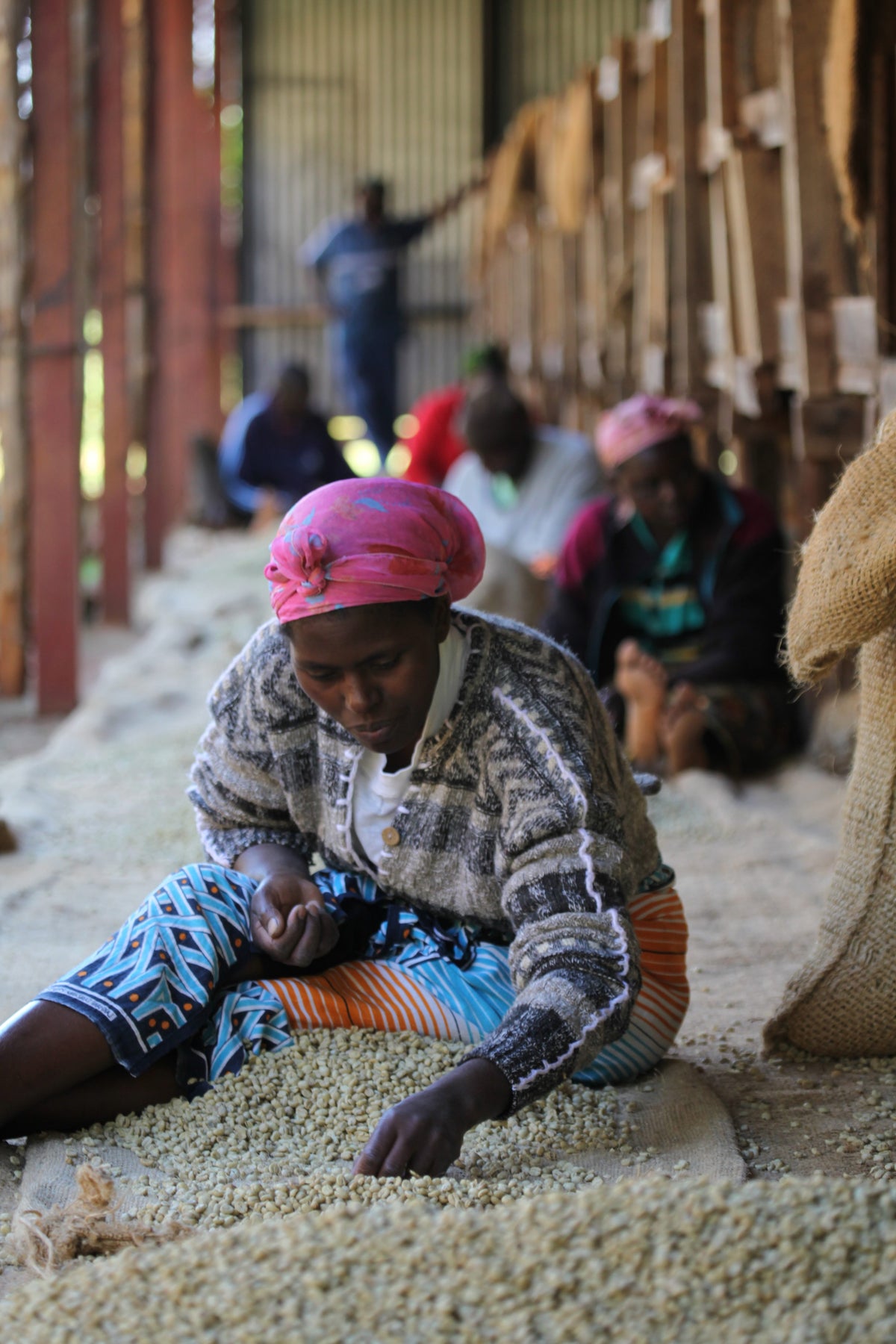
The cooperative sets aside money from each harvest so members can receive advances for school fees, farm inputs and emergencies. At Kagumoini, pulped coffee ferments overnight before it is cleaned, soaked and dried on raised tables. Workers turn and sort it by hand over one to two weeks.
Kamwangi, Kirinyaga

About 500 member farmers of the Ngariama Farmers Cooperative Society deliver cherries to Kamwangi from farms at roughly 1,550 to 1,650 meters. Kamwangi has been a regular source of our Kenyan lots. Our 2022 Kamwangi AA earned a 94-point score.

Thunguri, Kirinyaga

Established in 1962, Thunguri belongs to the Kibirigwi Farmers Co-operative Society and serves about 1,095 member farmers. Each has around half a hectare of coffee, grown alongside crops such as macadamia, beans, banana, tea and maize.

Read moreShow less

The farms sit at 1,600 to 1,700 meters, and coffee pulp from the factory returns to them as mulch. We have bought Thunguri coffees over many harvests.

Our 2025 harvest selections also included Karogoto AA from the Tekangu Farmers Cooperative in Nyeri and Kibugu AB from the Kibugu Farmers Cooperative Society in Embu. Both were washed lots of SL28, SL34 and Ruiru 11.

“Kenya’s coffee grows mainly in the central highlands around Mount Kenya.”Kenya

About the land

Growing coffee in Kenya

Kenya’s coffee grows mainly in the central highlands around Mount Kenya, with other growing areas to the west, east and southeast. Typical elevations of 1,400 to 2,000 meters keep temperatures moderate, while deep, well-drained red volcanic soils support the trees.

Read moreShow less

Nearly all Kenyan coffee is Arabica, and around nine-tenths is washed. Smallholders deliver cherries to cooperative factories; privately owned estates process their own. Washed processing removes the fruit before the beans are fermented, rinsed and dried in their parchment skin.

SL28 and SL34 remain closely associated with Kenyan coffee, though both are vulnerable to coffee berry disease and leaf rust. Ruiru 11 and Batian were released to help farmers reduce disease losses. Reliable figures for each variety’s share of the crop are unavailable.

Two rainy seasons shape two harvests in many growing areas. The larger main crop is picked roughly from October to December. The smaller “fly” crop falls in the first half or middle of the year, with timing varying by region and rainfall. Processing, drying, milling and grading can take several months before a lot reaches sale.

A brief history

Coffee was first planted in Kenya’s Taita Hills in 1893 and soon spread to the highlands near Nairobi. Colonial policy kept Arabica largely in settler hands; in some places, officials uprooted trees planted by African farmers.

Read moreShow less

Limited African coffee-growing schemes began in the mid-1930s. Access expanded under strict controls after 1947 and accelerated during the 1950s under the Swynnerton Plan, drawn up during the Mau Mau Emergency. Smallholders using family labor proved competitive with settler estates.

After independence in 1963, cooperatives and Nairobi’s weekly auction remained central to the industry. Production peaked in 1987/88, then declined amid falling prices, payment delays, rising costs, disease and cooperative management problems. Coffee land near Nairobi was also lost to housing and other uses. Subsequent reforms have sought to improve marketing and farmer payments, but production remains well below its 1980s peak.

From the journal